mymesh.improvement.TaubinSmoothing#
- mymesh.improvement.TaubinSmoothing(M, Lambda=0.6, Mu=-0.6382, pass_band=None, options={})[source]#
Performs Taubin smoothing [Tau95]. Taubin smoothing uses a two-step smoothing process where Laplacian smoothing is performed in the first step, with the amount of smoothing weighted by the parameter Lambda, followed by a second pass of smoothing weighted by the negative parameter Mu, which counteracts the shrinkage, thus preserving volume better than Laplacian smoothing.
- Parameters:
M (mymesh.mesh) – Mesh object to smooth
Lambda (float, optional) – Smoothing coefficient. Must be greater than 0 and less than abs(Mu), recommended to be less than 1, by default 0.6
Mu (float, optional) – Inflation coefficient. Must be less than zero and greater in magnitude than Lambda, by default -0.6382. Ignored if pass_band is given.
pass_band (float, optional) – Pass band frequency. The pass band frequency is a function of Lambda and Mu (kpb = 1/Lambda + 1/Mu). If provided, this will override the value for Mu. By default, None (the default Lambda and Mu give a pass band frequency of 0.1).
options (dict) –
Smoothing options. Available options are:
- methodstr
’simultaneous’ or ‘sequential’. Specifies if smoothing is performed on all nodes at the same time, or one after another. Simultaneous laplacian smoothing will move nodes to the center of their neighbors’ initial positions, while sequential will use the current positions of previously smoothed nodes, by default ‘simultaneous’.
- iterateint or str
Fixed number of iterations to perform, or ‘converge’ to iterate until convergence, by default ‘converge’.
- tolerancefloat
Convergence tolerance. For local Laplacian smoothing, iteration will terminate if the largest movement of a node is less than the specified tolerance, by default 1e-6.
- maxIterint
Maximum number of iterations when iterate=’converge’, By default 10.
- FixedNodesset or array_like
Set of nodes that are held fixed during iteration, by default none are fixed.
- FixFeaturesbool
If true, feature nodes on edges or corners (identified by
DetectFeatures()) will be held in place, by default False.- FixSurfbool
If true, all nodes on the surface will be held in place and only interior nodes will be smooLambdathed, by default False.
- limitfloat
Maximum distance nodes are allowed to move, by default None
- constraintnp.ndarray
Constraint array (shape = (m,3)). The first column indicates nodes that will be constrained, the second column indicates the axis the constraint will be applied in, and the third column indicates the displacement of the given node along the given axis (e.g. 0 for no motion in a particular axis))
- Returns:
Mnew – Mesh object with the new node locations.
- Return type:
Examples
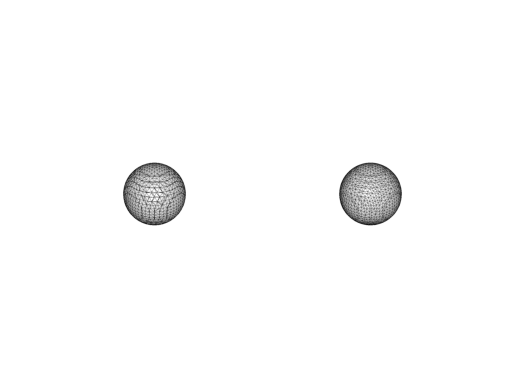
M = implicit.SurfaceMesh(implicit.sphere([0,0,0], 1), [-1,1,-1,1,-1,1],  .1)
Mnew = improvement.TaubinSmoothing(M, options=dict(iterate=1))

visualize.Subplot([M, Mnew], (1,2), bgcolor='w', show_edges=True)